Mission-Critical Wire Platform

Wire Transfer Applicaation


Role

Senior Manager, UX & Engineering - Product Lead & Principal IC

Company

First Republic Bank

Initiative

Wires Lite - Mission-Critical Backup Wire Platform

Platforms

Internal Enterprise Application (B2B Treasury Operations)


Project Overview

New Project Build

Wires Lite was a streamlined, mission-critical version of the bank’s primary wire transfer platform, GPP (Global Payment Processor). The goal was to rapidly build a reliable backup application capable of handling extreme transaction volume during a financial crisis. The system needed to support over $4 trillion in annual wire transfers across a broad range of high-net-worth and institutional customers, while maintaining strict compliance, security, and operational controls.

To meet the urgency of the situation, we assembled a dedicated cross-functional team of designers and engineers and delivered the first functional release in just two weeks. Wires Lite provided bankers with a simplified, high-efficiency workflow that ensured business continuity, reduced operational risk, and preserved critical treasury operations during a period of significant instability.

The Problem

The existing primary wire-transfer system (GPP - Global Payment Processor) was failing under unusually high transaction loads, causing severe performance degradation, processing delays, and increased operational & financial risk for high-net-worth and institutional clients. There was an urgent need for a reliable, streamlined backup system that could handle large volume without compromising compliance, security, or reliability - under a very compressed timeline.
Constraints & Considerations

  • Performance & Scalability: Must support very high transaction volumes; system architecture and UX had to anticipate heavy load.
  • Compliance & Security: High-stakes financial transactions, audit trails, data integrity, role-based permissions, and regulatory compliance were non-negotiable.
  • Time Pressure: First functional release delivered in two weeks. Extremely aggressive sprint requiring prioritization of core flows.
  • User Base: Internal bankers / operations staff with varying familiarity - designs had to balance speed for power users with clarity for less frequent users.
  • Risk Tolerance: Any UX error could cost real money or regulatory risk - need to minimize human error, ensure state clarity, auditability, and performance.

My Role

  • Ownership of end-to-end UX strategy and delivery from discovery, workflow mapping, to final UI and production hand-off.
  • Led cross-functional team of designers and engineers under tight timeline, aligned stakeholders (ops, compliance, engineers) to define scope and priorities.
  • Conducted workflow design and information architecture, mapping complex banking operations into clear, minimal flows under constraints.
  • Delivered wireframes, prototypes, and high-fidelity UI, iterated with internal stakeholders to ensure compliance, usability, and performance.
  • Coordinated with engineering to handle feasibility, constraints, and rapid development cycles; ensured design-to-implementation alignment under tight schedule.
  • Managed internal usability reviews, QA feedback loops, and compliance/risk alignment to launch a production-ready system.

Research

Research & Insights

  • Workflow mapping & stakeholder workshops: Gathered requirements from operations, compliance, and treasury SMEs to document every step of current wire processes, pain points, bottlenecks under load, and audit/compliance needs.
  • Task flow analysis: Mapped current state flows, identified failure points under load, complexity, and risk of errors, distilled to core actions required for a minimal viable backup flow.
  • Usability constraints for enterprise experts: Recognized that users are highly experienced bankers whose priority is transaction speed, data accuracy, and minimal cognitive load, not visual polish; UI must communicate state, status, and audit information clearly.
  • Design assumptions & risk mitigation: Understood that any design must support compliance, error prevention, auditability, and traceability, especially given high-value transfers.

Design Stratgy

  • Adopted a “minimum viable but enterprise-grade” design philosophy, core workflows only, with maximum stability, clarity, and audit transparency.
  • Established state-based UI variations (draft, in-process, completed, canceled) to clearly communicate the transaction lifecycle and reduce errors.
  • Designed modular form layout with collapsible sections to manage complexity while reducing cognitive load during data entry, supporting speed and accuracy in high-stress situations.
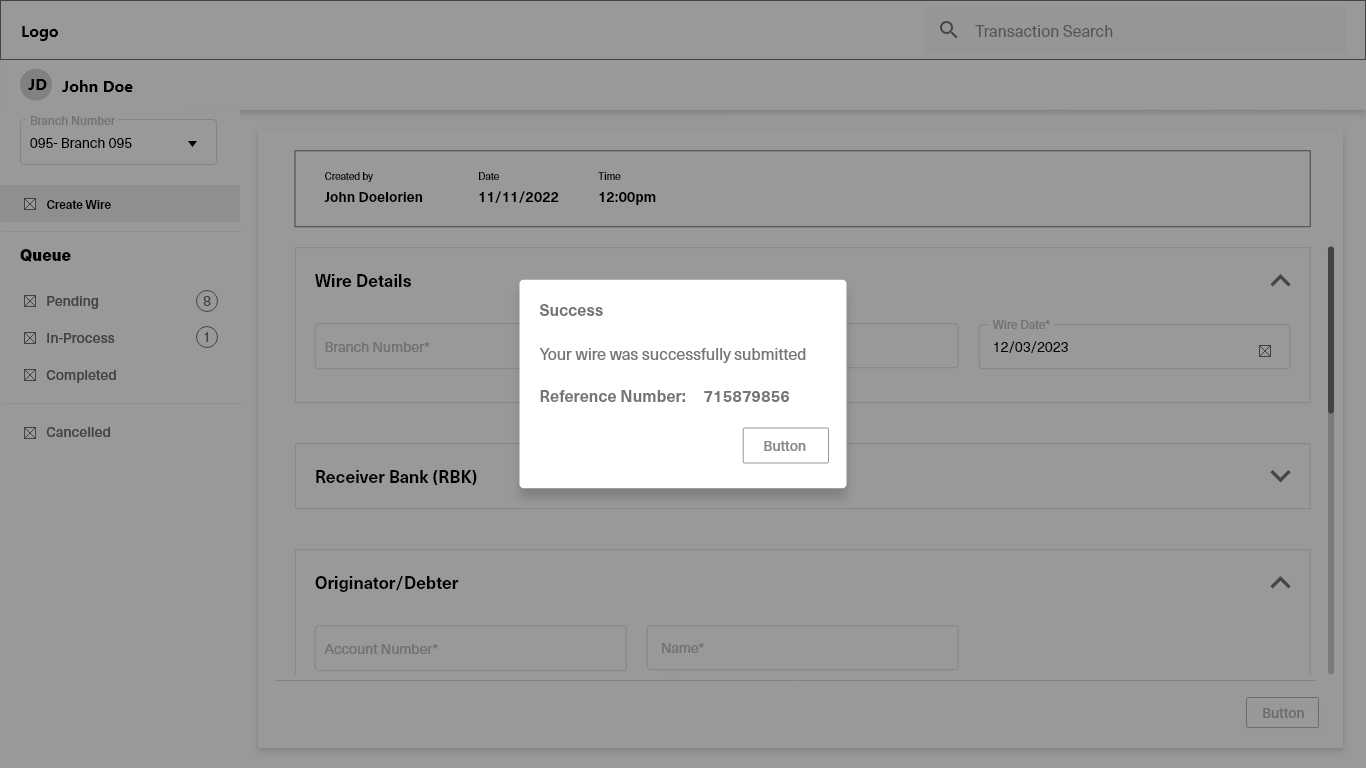
  • Built a consistent, reusable component library and pattern to support state-based headers, audit trails, and conditional UI states (editable vs locked, error / canceled, success, pending) ensuring scalability and maintainability.
  • Prioritized visibility of critical information (status, reference ID, audit trail, user info) across all states to meet compliance and user needs.

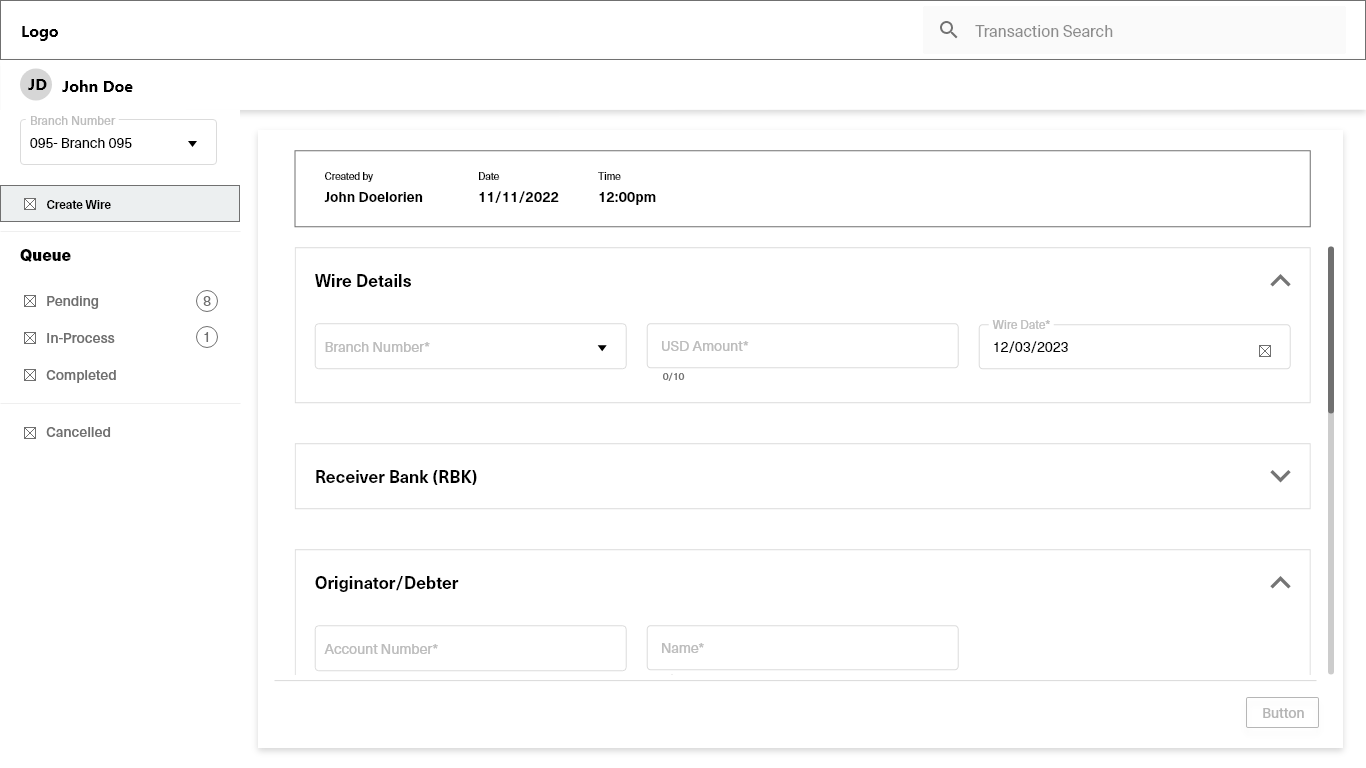
Low-Fi Wireframes

Exploration & Prototyping

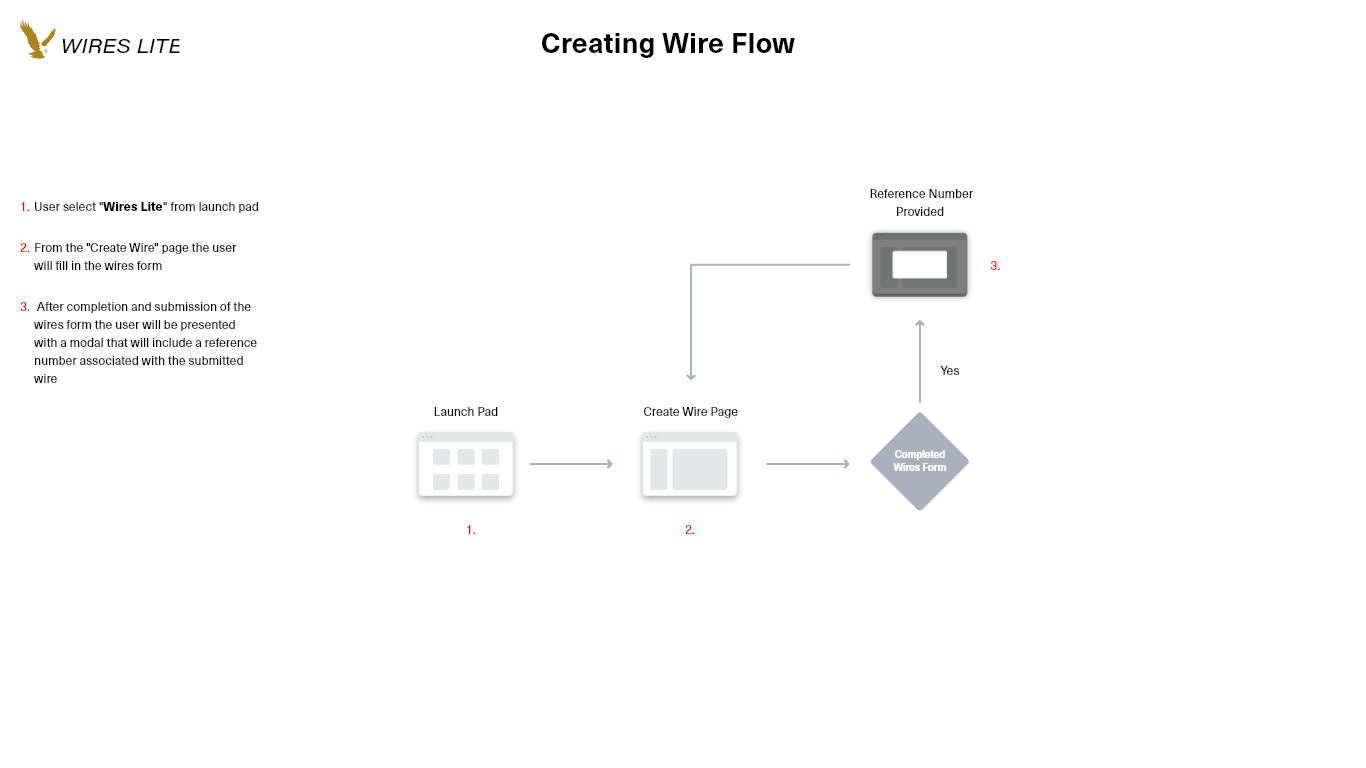
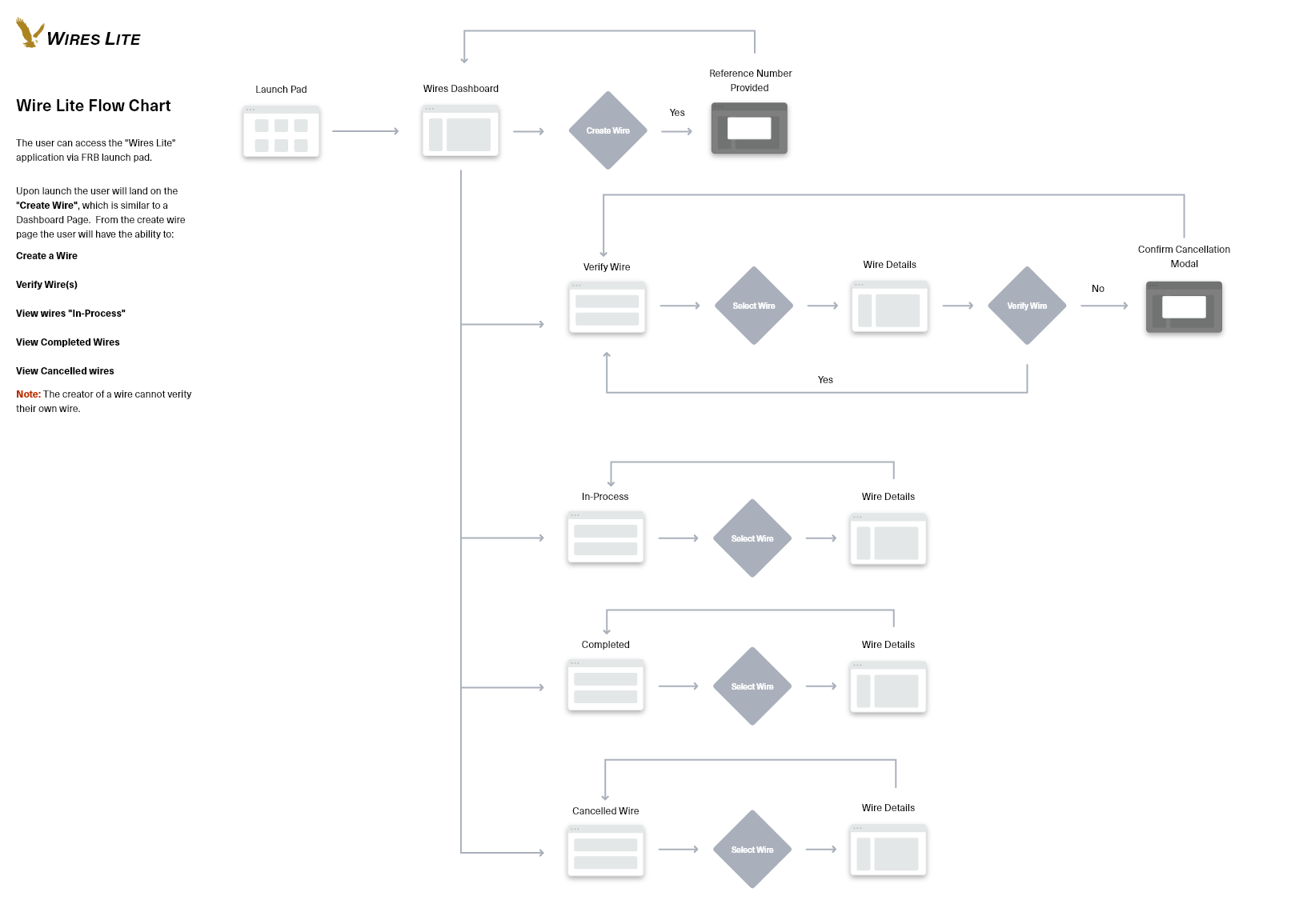
  • Started with low-fidelity wireframes and flow diagrams to outline end-to-end transaction flows (create → verify → process → complete/cancel), review-state transitions, audit states, and branching for edge cases.
  • Conducted internal stakeholder walkthroughs (ops, compliance, engineers) to validate flow logic and ensure all regulatory requirements were covered.
  • Delivered high-fidelity UI mockups and prototype screens for all core flows: “Create Wire,” “In Process,” “Completed,” “Canceled” with state-based headers, audit info, form validation, layout reuse, and consistent navigation.
  • Iterated rapidly in code/design hand-offs to meet the two-week delivery deadline, balancing minimal viable product with compliance and usability.

Final Design

The Solution

  • A fully functional Wires Lite application streamlined, reliable, and compliant ready to serve as a backup for the main wire system.
  • Modular design system and UI component library supporting state-based workflows and audit/compliance needs.
  • Clean, minimal, high-usability interface optimized for speed, clarity, and error prevention under load.
  • Adaptive UI states (draft, in-process, completed, canceled) with clear visual cues (status headers, audit trails, locked vs editable states) to guide users through workflows confidently and safely.
  • Consistent navigation and layout patterns to reduce training overhead and support efficient user adoption.
  • Guided entry flow with structured, collapsible sections (Wire Details, Receiver Bank, Originator/Debtor) to reduce cognitive load and support error-free data entry.
  • Neutral header state indicating that the wire is in draft mode and has not entered the processing workflow.
  • Persistent form layout reused across all states, reducing training time and supporting muscle memory for bankers.
  • Primary "Submit" action anchored at the bottom-right, ensuring fast and intuitive submission for long forms.

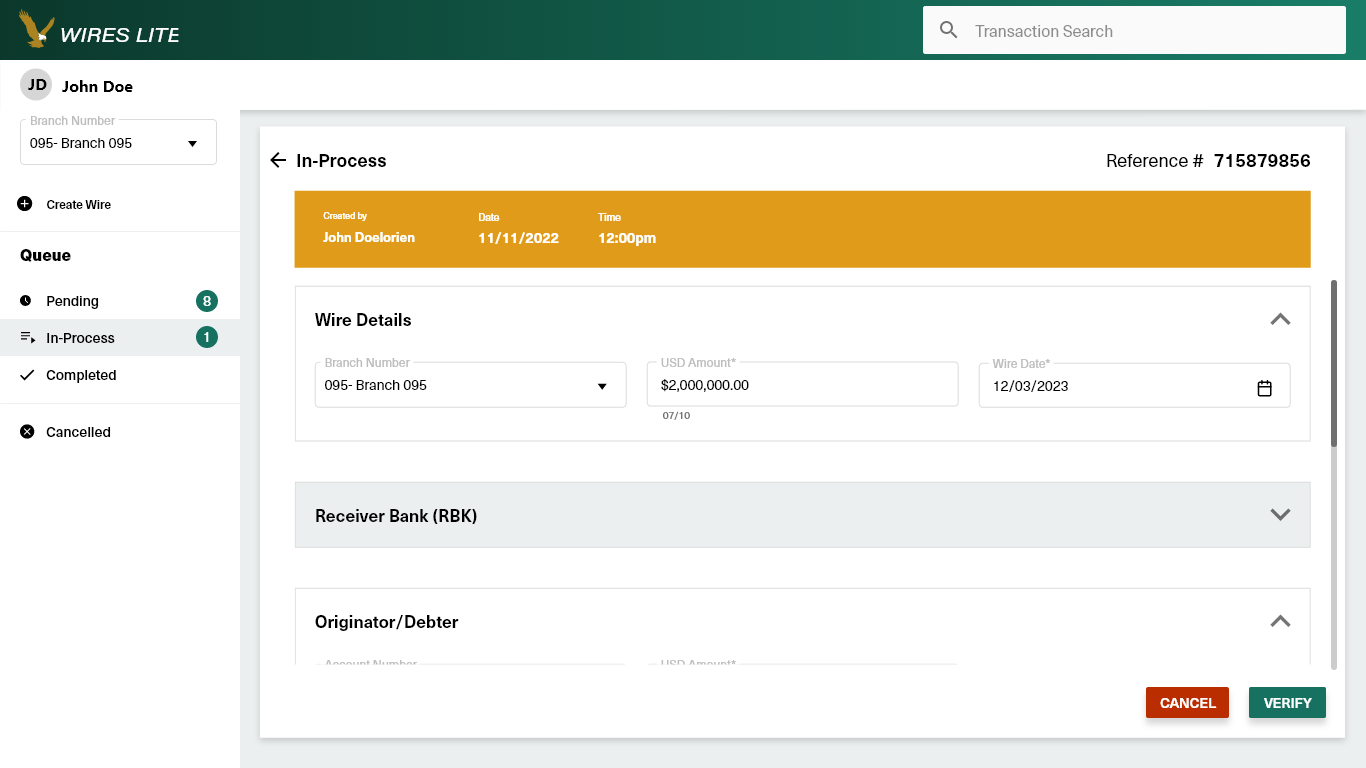
In Process

  • Amber “In-Process” header visually communicates that the wire is awaiting verification, creating an immediate sense of status and urgency.
  • Creator audit summary provides essential context (Created by, Date, Time) to support verification accuracy and compliance.
  • Editable detail sections allow verifiers to correct or update financial information before approval.
  • Pinned reference number ensures quick lookup during review or cross-checking.

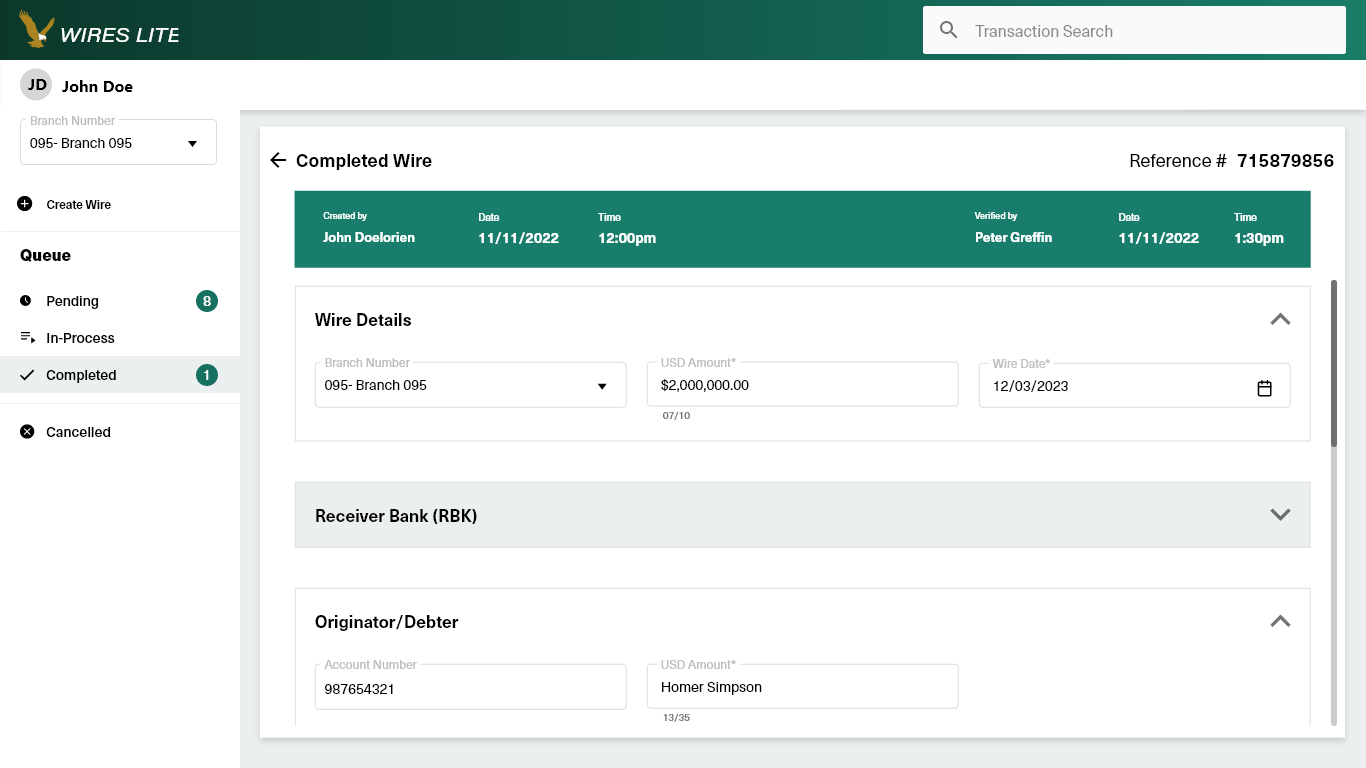
Completed

  • Green completion header reinforces success and finality, reducing ambiguity in high-volume workflows.
  • Dual audit trail displays both the creator and verifier with timestamps, promoting transparency and meeting regulatory requirements.
  • Read-only form fields lock post-processing details to prevent accidental or unauthorized changes.
  • Queue-status integration automatically updates the left nav, helping bankers track workload distribution.

Canceled Wires

  • Red cancellation header communicates a terminated transaction state instantly, preventing misinterpretation.
  • Canceled-by audit information (user, date, time) enhances traceability for exception handling.
  • Read-only details ensure canceled wires cannot be altered and remain compliant with auditing standards.

Going Forward

Impact

  • Delivered a fully functional backup wire application in 2 weeks, mission-critical for business continuity under stress
  • Provided fail-safe support for $4 trillion+ in annual wire transfers, supporting business resilience under heavy load or system instability.
  • Reduced operational risk by enabling a stable alternative workflow, avoiding performance degradation during spikes.
  • Streamlined workflow and clarity reduced potential for banker error and compliance risk.
  • Delivered a reusable design system foundation, enabling future extensions or scaling without redesigning core flows.

Collaboration & Cross-Functional Work

  • Engaged with engineering, compliance, operations, and leadership stakeholders to define scope, requirements, and constraints.
  • Facilitated workshops and requirement-gathering sessions with senior stakeholders and SMEs to align on priorities under urgent timeline.
  • Coordinated design-to-engineering handoff, QA feedback, and internal usability reviews ensuring compliance and performance even under time pressure.

Key Takeaways

  • Simplicity + clarity matter the most in mission-critical, high-risk enterprise tools, even more than visual polish.
  • Under urgent timelines, prioritizing core flows and compliance while maintaining modular design allows rapid delivery without sacrificing quality.
  • Modular design systems and reusable UI patterns are invaluable for scalability, maintenance, and future expansion.
  • SClose cross-functional collaboration, stakeholder alignment, and clear documentation are essential when building high-stakes enterprise applications.
  • State-based UI and clear feedback affordances are critical for trust, error prevention, and compliance in financial systems.